

Key Takeaways:
- Major Muscle Groups & Best Strength Exercises
- The body has 10 major muscle groups, each requiring specific exercises for balanced strength.
- Lower Body:
- Quadriceps (Squats, Leg Press, Lunges)
- Hamstrings (Leg Curls)
- Calves (Calf Raises)
- Upper Body:
- Chest (Pectorals) (Bench Press, Flyes)
- Back (Lats, Traps) (Pulldowns, Rows, Shrugs)
- Shoulders (Deltoids, Traps) (Press, Lateral Raises)
- Arms (Biceps, Triceps, Forearms) (Curls, Dips, Pushdowns)
- Core:
- Abs (Crunches, Leg Raises)
- Lower Back (Back Extensions, Good Mornings)
- Workout Tip: Train larger muscles first, alternating push and pull movements for recovery.
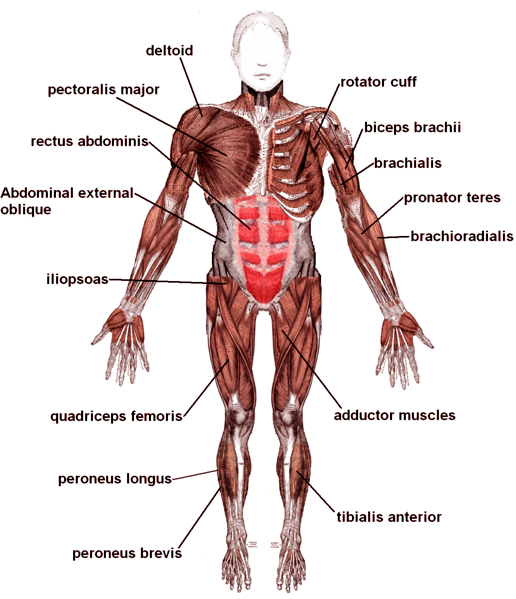
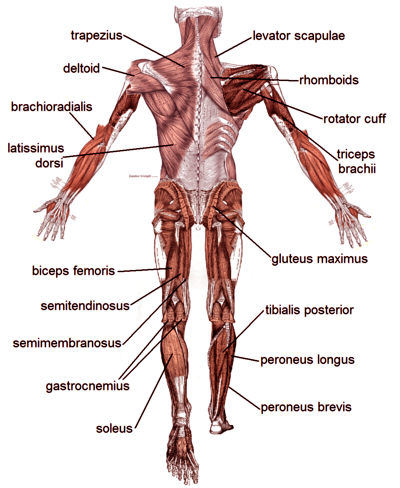
All the major muscle groups of the body from front and back.
Click on the name of the muscle, or the image, to see weight training exercises. The abdominal muscles are shown in red, it is very easy to see from this diagram how a six pack is made, and also why some people have an “eight pack”.
Below the muscle diagrams we have listed a series of exercises which work each muscle. There are linked to our individual weight training exercises and group exercise pages. To work these muscles start one of our weight training workouts.
Fun facts: Did you know that that glutes (gluteus maximus) are the largest muscles in the body? These shape our bottoms, so if you are looking to develop a firmer butt, get squatting.
[adinserter block=”1″]
Lower body
Quadriceps (front of legs)
Compound exercises for the quadriceps also involve the glutes (buttocks), hamstrings and calves.
- Rear Squat (compound)
- Front Squat (compound with core strength)
- Leg press (compound)
- Deadlift (compound)
- Lunge (compound)
- Leg extension (isolation)
Hamstrings (back of legs)
- Leg curl (isolation)
Calves
- Standing calf raise (isolation)
- Seated calf raise (isolation)
Upper body
Compound exercises for the pectorals also involve the triceps and front deltoids.
- Bench press (compound)
- Pullover (compound)
- Flye (isolation)
5. Lats (upper back)
Compound exercises for the lats also involve the biceps and rear deltoids.
- Pulldown (compound)
- Bent-over row (compound)
Deltoids and Trapezius (shoulders)
Compound exercises for the shoulders also involve the arm muscles.
- Upright row (compound)
- Shoulder press (compound)
- Lateral raise (isolation)
- Shoulder shrug (isolation)
Arms
Triceps (back of arms)
- Parallel bar dip (compound)
- Pushdown (isolation)
- Triceps extension (isolation)
Triceps Training Exercises
Biceps (front of arms)
- Bicep curl (isolation)
Brachioradalis / Pronator teres (forearms)
Strengthening forearms and grip strength is essential to allow you to move on to lifting heavier weights. Unless you use wrist hooks, strong grip is vital for deadlifts, cleans, shoulder shrugs and rows as your progress with the weight.
Waist
Compound exercises for the abdominals also involve the hip flexors.
- Leg raises (compound)
- Crunch (isolation)
Lower back
Some compound exercises for the legs also involve the lower back.
- Back extension (isolation)
- Good-morning (mentioned on the Bruce Lee workout) (isolation)
Bodybuilders commonly divide the body’s individual muscles into ten major muscle groups. These do not include the hip, neck and forearm muscles, which are rarely trained in isolation. The most common exercises for these muscle groups are listed above.
The sequence shown above is one possible way to order the exercises. The large muscles of the lower body are normally trained before the smaller muscles of the upper body, because these first exercises require more mental and physical energy. The core muscles of the torso are trained before the shoulder and arm muscles that assist them. Exercises often alternate between “pushing” and “pulling” movements to allow their specific supporting muscles time to recover. The stabilizing muscles in the waist should be trained last. First ensure that you are familiar with all the major muscles.
I’m having pretty bad shin splints with pain on the insides of my legs right below my calf. Any idea what this specific muscle is caused? Know of any good exercises to strengthen this muscle or any other muscles that would take stress off my stained muscle?
Not sure what muscles are causing the problem. The general treatment for shin splits is to rest the legs, use ice packs after training, do some gentle stretching of the lower leg muscles. If the pain is too much to handle then take some anti-inflammatory medications. Compression and elevation if recommended if there is swelling.
Shin splints generally occur due to excessive usage and respond to rest and recovery. If problems persist you should get it checked by a doctor as it may not be shin splints. There could be a fracture or other tendon problems. Best to know.
I rested and did a lot of icing after I first got the “shin splints”. I returned after about 2 weeks of rest but they came back. I did some research and I think it may be the flexor hallucis longus that is giving me trouble. It seems the recovery plan for this is RICE and light stretching and strengthening exercises. If this continues I might have to go see a doctor. Thanks.
i have a tear in my levator scapulae and i am a very active volleyball player. i can not stop playing what exercises can help build strength?
That is a tricky one Gemma, really you should seek advice from a doctor or ideally a sports physiotherapist. Depending on the severity of the tear the recommended course of action may be massage, manipulation and rest, rather than strengthening exercises to start with to aid recovery. Doing too much may make the condition worse and lengthen the period of injury, so seek advice. It really would be wise to stop playing for the time being.
I want to lose my fat i hv on my tummy i love to lose my fat tummy
Hi Teresa, we have a page dedicated to this topic: http://www.motleyhealth.com/how-to-lose-belly-fat
hi again! i’m taking muay thai at a martial arts studio that i work at, and i know how much the elbows, knees, and legs are utilized. i was hitting a heavy bag with my shin alot and it really started to hurt the next morning. so i was just wondering, are there any exercises to strenghten the shin bone and overall leg muscle?
Hi Nino, kicking a heavy bag is a good start to conditioning the shins and strengthening the legs. Specific strengthening exercises include lunges and squats. Shin conditioning can be done by shin kicking tyres and rubbing them with wooden sticks (e.g. Filipino sticks). Best talk to the Muay Thai instructor though, they are bound to have their preferred methods.
Ill really like to know where in miami or who must i contact to have a muscle diagram. I have to see if i have crooked abs or model abs?
Adrian, go and see a doctor, of you have a muscular problem they will be able to tell you.
hi wonder ifi was to keep a bit of tension or more on my abdomen muscles to see if this can help maintain the tummy shape?
Hi Glenn, that does help a little, but more reps and more resistance probably helps more.
Hi, when im running, regardless of how much i stretch or not stretch or how much water i drink, my calfs are agony after running about half a km causing me to stop even though the rest of my bodys willing to go on. Any ideas why this might be?
Tricky Kenny, it could be that they are currently weak and will improve, or it could be that there is an issue with gait, posture etc. that needs looking at. Performing calf raises will strengthen them and this might help.
I had shin splints once as a runner. I incorporated this exercise every day until they were gone, then again if I felt the slightest hint they were returning.
Sit on something high enough to dangle your legs. Hang a 3 to 5 pound ankle or arm weight over the toes. Raise the foot up toward the knee 15-20 times, 3 times each side. This strengthens the muscles associated with shin splints, I cured other runners shin splints with this method. L
I am 71 years young. I have a hernia in the membrane down the middle of my stomach that holds the abs together. This makes sit-ups next to impossible. I’ve put on about 12# of muscle in my chest and arms. Also have built up my legs.My stomach the problem need to find out a way to flatten it.
I am a 6th grader and this helped me with my project
I’ve seen a couple comments above about shin splints. I used to have some pains like that I chalked up to growing pains when younger. Ten years or so ago knowledgeable employee at a local health food store told me about magnesium spray. I highly recommend!
Cramps or pain that bananas don’t alleviate? Try magnesium spray!
Probably would benefit just about everyone to take a good, proper ratio calcium magnesium supplement as well.