

So you want to lift weights? Here we teach you how to work out with the main weight training exercises, and a good gym workout for beginners, which provides the perfect introduction to Strength.
Weight training is not only an excellent way for athletes to improve performance but it is also a great way to lose weight and tone up. Regular weight training workouts increase total muscle mass which helps to raise metabolism.
This weight lifting for beginners guide is also suitable for both men and women. Although it still has a masculine image weight training is certainly something women should do to keep in shape. Cardiovascular exercise is great at burning fat but it does not help to tone and shape. A regular weight training workout can give a women slender legs and a toned butt without leading to unwanted bulky muscles.
Below we take you through the main weight training exercises and then provide a simple starters workout and also a more complex 5 week strength training program, which is also designed for beginners. These free weight workouts are the most popular beginner routines as they can be done at home or in the gym; they are all easy exercises that anybody can do. Most young men start weight training at home in their bedrooms before progressive to heavier weights in the gym. But if you have enough space, you can easily set up a home weights gym.
Upper Body Exercises
Bench Press
 The bench press is the main exercise for building a stronger chest and is featured most weight workouts. It is also the exercise which most people associate with weight training. To perform a basic bench press you just need to lie down flat on a solid bench and lift a barbell straight up from your chest until your arms are straight, and then lower. Grasp the barbell so that your forearms are vertical when in the lowest position.
You should always use a spotter or supports for safety. Read our full instructions on how to bench press which also provide several variations on the basic barbell bench press. And yes, that is Marilyn Monroe in the photo!
Bicep Curls
 Bicep curls are possibly the second most popular weight training exercise after bench press. You can perform bicep curls with a barbell, an EZ-bar which is designed to give a better grip position, or dumbbells. Simple grasp a bar or dumbbells with palms facing outwards and curl up towards your shoulders. If you wish to workout using just dumbbells take a look at our page on dumbbell workouts.
There are many variations that you can perform, such as hammer curls where you hold the dumbbells vertically, concentration curls where you rest your arm on your leg, or preacher curls where you use a special bench to rest the backs of your arms to focus the work on the peak of bicep (an isolation exercise).
Flyes
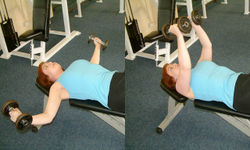
Chest flyes are done by lying on a flat bench with 2 dumbbells. Hold them out to your sides with slightly bent arms and then lift them up in an arc until they meet directly above your chest.
Many gyms also have Pec Deck machines where you sit upright to perform the same movement while under resistance.
To target different areas of the chest, then perform incline flyes to target the upper pectorals, and decline flyes to target the lower pectorals.
Lateral Raises
 Lateral raises are best done standing up straight with a dumbbell in each hand. Start by holding the dumbbells by your sides and then lift them both upwards and outwards until your arms a parallel to the floor or your hands just above the height of your shoulders, then lower again. Keep your elbows slightly bent.
An alternative exercise of the deltoids is a front raise done with a barbell. This just involves lifting a barbell from your hip in an arc with straight arms until it is directly in front of you.
You can exercise the rear deltoids by performing a bent over raise. Bend forward, keep your back straight and then lift the dumbbells out to each side.
Pushdowns
 This is an isolation exercise for the triceps. It is performed by using a cable machine / pushdown machine.
The bar should start at shoulder height, then while gripping the bar with the palms facing down, pull the bar downwards, keeping the elbows still and straightening the arms. An excellent triceps workout.
An alternative is the triceps extension that can be done by holding a triceps bar above your head and then lowering behind. Another method is to lie on a flat bench and grasp a dumbbell with both hands and lower it behind your head.
Shoulder Press / Military Press
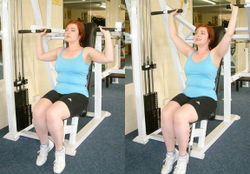
The shoulder press (or military press) is best performed while seated with a back support to ensure that the pectorals are not engaged by leaning back. After the bench press, this is one of the most popular weight lifting exercises.
They can be done with a barbell, dumbbells or using a shoulder press machine or Smith machine. Free weights provide the most natural movement.
Simply lift the weight from the shoulders straight upwards, then lower it down again. To isolate further it can be performed one arm at a time with a dumbbell. This compound exercise also involves the trapezius and the triceps. The Arnold Press is a variation of the shoulder press.
Triceps Extension / French Curl
 The triceps extension can be done while standing, sitting or laying down on a flat bench. A weight is held above the head (keeping the upper arms motionless), then lowered behind the head, and then raised to the starting position.
This is an isolation exercise for the triceps. It can be performed either with both arms or one arm at a time. This is also known as the French curl.
These can also be done with cable machines. Another variation to target the triceps with a dumbbell is the triceps kickback.
Upright Rows
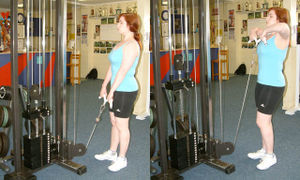 The upright row is performed while standing upright and pulling a weight from the waist to upper chest in a straight line up the torso.
It is a compound exercise that also involves the trapezius and the biceps. The narrower the grip the more the trapezius muscles are exercised.
It can be done with a barbell, dumbbells or using a resistance machine (pulley machine) as shown in the photo.
Lower Body Exercises
Leg Curl
 The leg curl is performed while lying face down on a leg curling bench by raising a weight with the feet towards the buttocks. This is an isolation exercise for the hamstrings.
This type of exercise requires the use of a specific piece of apparatus. It is very difficult to perform a leg curl using free weights at home.
Leg Extension
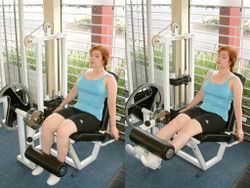 The leg extension is performed while seated on a leg extension machine. The feet are tucked under a weight (or pulley system) and then the weight is raised out in front of the body with the feet. It is an isolation exercise for the quadriceps.
You should not overtrain on this exercise. Ensure that you are training you legs in a balanced way. Many people make the mistake of overtraining this exercise in a gym because the machine is free and as it is a sitting down exercise it seems like less work! Work the legs with squats, lunges and calf raises to keep the muscles well
balanced.
Leg Press
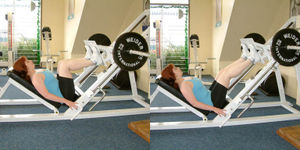 The leg press is performed while seated on a leg press machine. A weight is pushed away from the body with the feet. It is a compound exercise that also involves the glutes and, to a lesser extent, the hamstrings and the calves.
This works the same muscles as the barbell squat. However, the leg press machine allows you to isolate the muscles further as you are not engaging the stabilizing muscles. The range of motion is less than that of a squat, but it is a safer way if you are working out alone.
Calf Raises
Standing Calf Raises
 Calf raises are the only way to develop the calf muscles that run down the back of the lower leg. The two muscles of the calf are called the gastrocnemius and soleus, which form the upper and lower calf muscles. This is an isolation exercise for the calves, and particularly emphasises the gastrocnemius muscle.
Calves are often neglected by amateur athletes and bodybuilders. Arnold Schwarzzeneger famously failed to train his calf muscles in his early bodybuilding days, resulting in many amusing photos of him standing up to his knees in water to disguise his disproportionately developed calves.
Without a calf resistance machine, the easiest way to work the calf muscles is to simply raise your body up on to your toes, squeeze the calf muscles (important to remember the squeeze) and drop back to a stand.
Resistance can be added by either holding two dumbbells at your side, or as you progress by supporting a barbell across your shoulders, as you would in a squat. To work the calves more stand with your toes and balls of your feet on a small step to increase the range of movement when you rise and fall.
When lifting heavier weights, then a two legged calf raise has to be done, but while lifting lighter weights one legged calf raise is ideal, as it ensures that you work both calves equally.
The leg muscles (gastrocnemius, soleus, tibialis anterior and posterior, fibularis longus and brevis) are made up of the slow twitch fiber muscles and therefore it is generally thought that higher rep ranges should be performed to help build more leg muscle. However, there is still a big debate over what works best, higher or lower reps. Two sets of 8 reps should be sufficient to make good progress so long as the weight is such that the final raises are hard work. Just experiment until you find which rep range gives you maximum gains.
Seated Calf Raises

If you wish to isolate the calves further, then the seated calf raise does this.
Unlike the standing calf raise it requires a specific piece of equipment.
The seated calf raise is performed by flexing the feet to lift a weight held on the knees.
This is an isolation exercise for the calves, and particularly emphasizes the soleus muscle.
Squats
Squats are possibly the most important weight training exercise. They work the largest muscles of the body and are important in sports, athletics and martial arts. They are also the muscles which tone the backside, so a very good exercise for women to do, and are one of the best exercises for a toned butt. There are many variations on squats so they have their own article here: How to Squat.
Back Exercises
Back Extensions
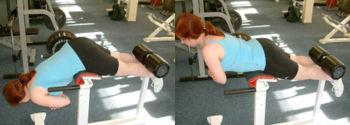
Back extensions are done while lying face down partway along a flat or angled bench, so that the hips are supported and the heels secured by bending down at the waist and then straightening up again.
It is a compound exercise that strengthens the core and also works the glutes.
It can be done on the floor with your hands held either side of your head (not touching your head). For the greatest range of motion use a dedicated back extension bench like the one shown in the photo.
Bent Over Row
 To perform this, support yourself on a workout bench with one knee and one hand. With the other hand lift a dumbbell from the floor to your side, until your upper arm is just beyond horizontal or at the height of your back. This is then lowered until your arm is extended and shoulder stretched forward.
A variation of this exercise can be performed using a barbell, by bending forward and pulling the barbell towards the chest. Keep your knees slightly bent and look forwards during lifting to ensure good form.
Deadlift
 Deadlifts are one of the most important exercises and as a result require a whole article on the subject. Basically a deadlift is performed by lifting a weight from the floor to your hips, keeping your arms straight and legs just slightly bent.
The lift is from the lower back and is powered through the hips initially. Read the article on How to Deadlift to learn more.
Pulldown
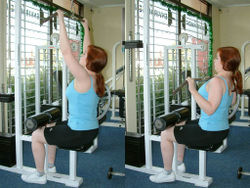
The pulldown is a compound exercise that works the upper chest, biceps and rear deltoids.
It works the same muscles as chin-ups / pullups, but uses a resistance machine (cable machine or pulldown machine) to allow you to work with weights lighter or much heavier than your bodyweight.
The pulldown is performed while seated by pulling a wide bar down towards the upper chest. Your knees should be tucked in under the supports so that you are not lifting yourself off the bench.
The exercise can be varied to work the lower lats harder (close grip pull downs) or the biceps (reverse grip pull downs).
Core Exercises
Crunches
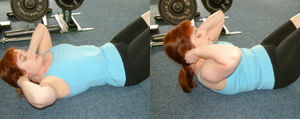
This is the classic abdominal exercise. It is performed while lying face up on the floor with knees bent and curling the shoulders up towards the pelvis.
This is an isolation exercise for the abs. For extra resistance and to build stronger abdominals use some weight, either by holding a weight disc or dumbbell to your chest or by using a crunch machine. Also a cable machine can be used by kneeling, facing away from the machine.
To work different areas of the abs perform the twisting crunches – this targets the obliques. Bicycle crunches are considered to be one of the best abdominal workouts.
Leg Raises
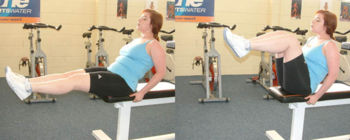 Leg raises are done by sitting on the edge of a weight lifting bench with your legs straight out in front of you. Lean back slightly to balance, then draw your knees to your shoulders.
These work the hip flexors and lower abs. They can also be performed by laying on the floor, holding onto a support behind your head (a partners ankles is ideal) and then lifting your legs up to a vertical position. If you wish to work the lower abs harder then lift your hips off the floor when your feet are at their highest point. The video below shows the basic leg raise.
To take the exercise further, perform hanging leg raises. Hang from a high horizontal bar (such as a pull up bar) and then raise your knees to your chest. Use ankle weights to increase resistance.
Putting The Exercises Into A Strength Training Program
You do not have to perform the weight exercises in this order, however, generally the large muscles of the lower body are trained before the smaller muscles of the upper body, because these exercises require more mental and physical energy. The core muscles of the torso are trained before the shoulder and arm muscles that assist them.
Exercises often alternate between “pushing” and “pulling” movements to allow their specific supporting muscles time to recover. The stabilising muscles in the waist should be trained last. Review the muscle diagrams to learn which muscles are worked with each exercise.
Although you could go through all these exercises in one gym session it really would be better to focus on just a few. There are many ways to put together a workout of your own.
One way would be to take 2 upper body exercises, 2 lower body exercises, a back exercise and a core exercise. Then for each of these 6 exercises perform 3 sets of 8 – 10 repetitions. You could do this twice a week, changing the exercises each session and also aiming to increase the weights every 2-3 weeks to build strength.
Another way would be to work on each body section separately with an upper body exercise day, then a lower body day and finally a back and core day. You could then add some cardio exercise into each workout and have 3 workouts a week with a cardio warm up and resistance training for the main workout. This workout is based on this principal: Full Body Weight Training Workout.
Once you learn the basic weight training exercises you really can just create your own routines based on your personal preferences. For general fitness and weight loss you do not need advanced training schedules.
Simple Beginners Weight Training Routine
Workout routines for beginners provide a good basic foundation for both men and women who wish to start building some all round strength. This one has eight different exercises, but none are done intensively. The warm up set should not be difficult for you to do, it is purely to ensure the relevant muscles are warmed up and the blood is flowing a little. The work reps should be more challenging, but to start with aim to be able to do two sets of 10 reps. Ideally you should be finding it difficult to complete the last set, but still have some reserves.
Ensure that you rest between each set, and rest a little longer between each set of exercises. Generally two minutes rest between is recommended, and then a few minutes more between sets of exercises.
This weight training for beginners routine concentrates on compound weight training exercises, i.e. exercises that work more than one muscle at a time. These types of exercise produce athletic, functional muscle tissue, and are also a great way to boost the metabolism and reduce body-fat. This is often taught as a simple barbell workout, although you can use either barbells or dumbbells, or a combination of the two.
| (Use Barbells or Dumbbells) | Warm up reps |
Work Reps |
| Squat | 20 | 2 sets of 10 |
| Dead-lift | 10 | 2 sets of 10 |
| Shrugs | 10 | 1 set of 10 |
| Shoulder Press | 10 | 2 sets of 10 |
| Bench Press | 10 | 2 sets of 10 |
| Bent Over Rows | 10 | 1 set of 10 |
| Curls | 10 | 2 sets of 10 |
| Triceps Extensions | 10 | 2 sets of 10 |
Once you have been doing this routine for a while, you should start to recognize your weaknesses, or identify some new goals. It is good to set mini goals when weight training, as it is important that your goals are attainable over a short period of time, as well as challenging.
Final Points on Starting Weight Training
If you set you goals too high, you may soon become frustrated at your perceived slow progress. Some simple goals to set early on can include: aiming to perform a 10 set bench press at your current 1RM (one rep maximum) or to squat your own body weight, if you cannot already. It is good to set some targets, but don’t set them too high or you will only disappoint yourself. It is also good to supplement your weight training with other exercises such as triceps dips, press ups and sit ups which ensure you develop good core body strength.
If you are a martial artist or do circuit training then you probably already do these exercises each week, but if not they are great exercises to add to your weekly routine. Once you build up your strength, and if your objectives are for bigger muscles (bodybuilding) then you can start concentrating on specific body parts.
One final point – while you can learn much from a website, book or video, it can sometimes pay to receive some personal instruction so that you learn proper weight lifting techniques – good form prevents injury and increases muscular development.
Hi, I’m Furaha from Tanzania, I want to lose fat but I do no have those exercising tools how can I do it?
Hi Furaha, the first step is to change your diet – look at our diet section for advice. For exercise, anything will help – go running, do bodyweight circuits, swim, cycle, walk (lots) – see our fitness section for more on this.
Hey I am very new to weight lifting and I want to start doing this but the problem is that I do not know what weight should I lift? My weight is 58 kgs and my height is 5ft 7 inches. please help.!
Hi Avishek. Start light and experiment to find out what you can lift. For the first workouts lifts a weight that allows you to perform around 12-20 repetitions slowly and steadily. Get used to handling the weights, lifting with good form. Perform a few sets for each exercise. Take some notes as you go – write down the weight used and how many sets / reps you performed, and note if it was easy, quite hard, very hard etc. Then in the next session adjust accordingly, and aim to lift each weight 10-12 times (reps) with a good form. Just make a judgement based on the last session. Take notes again. Soon you will know what you are currently lift comfortably (well, not too comfortably!) and then start working on slowly increasing the amount you lift. Always keep a note of your last workouts.
Hi,I like the look of this routine, just a technical question. Do I do the warmup exercises all at the start, or do I do a warmup for each exercise just before I do the excercise? As well I am wondering how long it should take to complete the full workout in the 5 week plan per day.
Hi Reo, yes, do the specific warm-up set immediately before the main workout. You should also do a general warm up for a few minutes befire, such as rowing, cross trainer etc. The workout should take about an hour, maybe a little longer. Depends on the speed you lift and the rest between sets. Allow at least an hour. If it takes a lot longer report back.
how can i lose weight when im a stay at home mom is there anyway or anything i can use as weights just at home stuff i really need help i wanna be the hot mom i never was
Hi Chantel, there are many options. Body weight exercises and circuit training routine will get you in shape. Controlling your eating is vitally important too. Take a look at these options:
Strength Training For Women – you will need some dumbbells
20 Minute Home Workout
Circuit Training Workouts
First of all I want to say the program up top looks really cool. I am 6’1 mmm about 280lbs medium. last year I was about 240… so I managed to pack on 40lbs.. some say because my wife got pregnant I say because some reason I just wanted to eat bad. I finished the P90x program to lose the weight but now I don’t have the room to do it again.. so I recently got gym membership. My question is.. is this a good program for good for me? I never had to workout at the gym before.. actually I am a little scared because I don’t know where to start when I go there. My goals are to build muscles and burn off this fat simultaneously.. I would like to drop 80lbs Fyi.. I always started cleaning up my diet. :) Thanks in advance for your help.
D. Jiles
Hi D. Jiles,
The best way to build muscle and burn off fat is to do a combination of strength training and cardio, while also eating sensibly. This workout is certainly a good place to start. But also do some high intensity interval training, some longer cardio sessions and some combination workouts, like a kettlebell workout, BodyPump or other intensive, high rep form of resistance training.
Remember, building muscles requires you to feed those muscles with plenty of protein and carbs. This is not the quickest route to losing fat when done alone. Basically, mix it up, do not rely on just one type of exercise. Use cardio and HIIT to burn fat and weight lifting the build muscle, keep the diet lean. Focus on getting fitter and stronger – log your workouts and make sure each week you are lifting more, going further.
Hi,
I was wondering if the weights mentioned in the 5 week programme (eg 50kg for squats) would be suitable for women or whether I should lower them. I’m not sure I could lift 50kg over my head in order to do the squats.
Hi Stacey. By all means start with a much lighter weight to learn what you are currently capable of. Ideally squats should be done in a squat rack where the bar is supported at shoulder height so that you do not need to lift it into position. If you have access to a gym then there should be a squat rack there, or alternatively you could use a leg press machine instead.
Hi, i’m 18 this year. I have never been to gym or lift weights before. I do not know how to start ths fitness journey as there’s no one to guide me and do it with me. Going to gym is intimidating, to add on I do not know how to use the equipments. I really want to be fit and tone. I have tried doing cardio at home and I will stop halfway.
Hi Xin, most equipment in a gym is easy to use, and a good gym will have instructions on machines. Also, try not to be intimidated by the others in the gym – if you ask somebody (when they are not lifting) how a machine works, they will probably be happy to show you.
Hi motley
It’s great site , got routines , well explained .. Nice work
I been to gym since last 10-12 years on and off .. Means go once a month in year in summer and then left off completely
I got fat around belly mostly ..40 inches belly . Please suggest what routine I should follow . Please advise ( if possible diet plan included)
Also want to lose some fat from neck and face as I see my self chubby
Please advise
Steady cardio, such as walking uphill, with weight training. Burn calories, reduce food intake, and get some strength training in too.