

Key Takeaways:
- Major Muscle Groups & Best Strength Exercises
- The body has 10 major muscle groups, each requiring specific exercises for balanced strength.
- Lower Body:
- Quadriceps (Squats, Leg Press, Lunges)
- Hamstrings (Leg Curls)
- Calves (Calf Raises)
- Upper Body:
- Chest (Pectorals) (Bench Press, Flyes)
- Back (Lats, Traps) (Pulldowns, Rows, Shrugs)
- Shoulders (Deltoids, Traps) (Press, Lateral Raises)
- Arms (Biceps, Triceps, Forearms) (Curls, Dips, Pushdowns)
- Core:
- Abs (Crunches, Leg Raises)
- Lower Back (Back Extensions, Good Mornings)
- Workout Tip: Train larger muscles first, alternating push and pull movements for recovery.
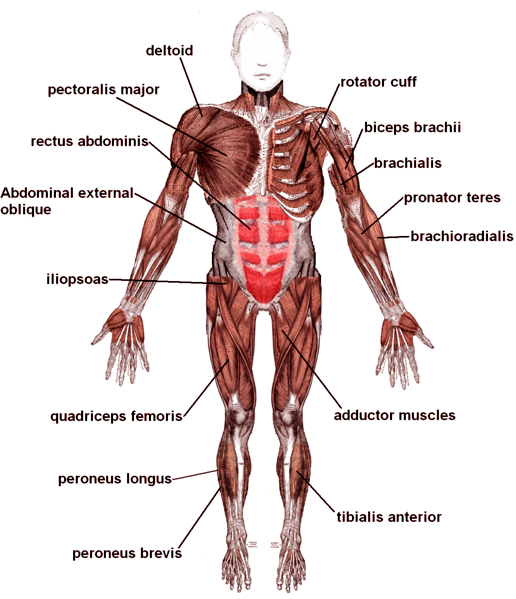
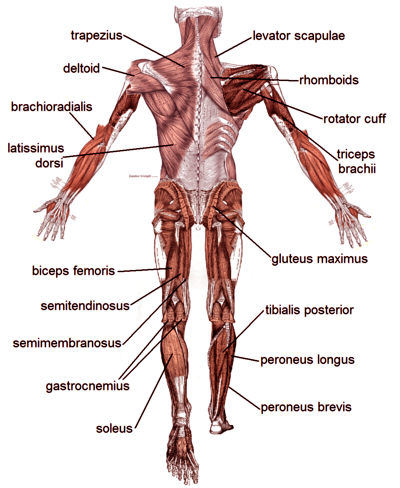
All the major muscle groups of the body from front and back.
Click on the name of the muscle, or the image, to see weight training exercises. The abdominal muscles are shown in red, it is very easy to see from this diagram how a six pack is made, and also why some people have an “eight pack”.
Below the muscle diagrams we have listed a series of exercises which work each muscle. There are linked to our individual weight training exercises and group exercise pages. To work these muscles start one of our weight training workouts.
Fun facts: Did you know that that glutes (gluteus maximus) are the largest muscles in the body? These shape our bottoms, so if you are looking to develop a firmer butt, get squatting.
[adinserter block=”1″]
Lower body
Quadriceps (front of legs)
Compound exercises for the quadriceps also involve the glutes (buttocks), hamstrings and calves.
- Rear Squat (compound)
- Front Squat (compound with core strength)
- Leg press (compound)
- Deadlift (compound)
- Lunge (compound)
- Leg extension (isolation)
Hamstrings (back of legs)
- Leg curl (isolation)
Calves
- Standing calf raise (isolation)
- Seated calf raise (isolation)
Upper body
Compound exercises for the pectorals also involve the triceps and front deltoids.
- Bench press (compound)
- Pullover (compound)
- Flye (isolation)
5. Lats (upper back)
Compound exercises for the lats also involve the biceps and rear deltoids.
- Pulldown (compound)
- Bent-over row (compound)
Deltoids and Trapezius (shoulders)
Compound exercises for the shoulders also involve the arm muscles.
- Upright row (compound)
- Shoulder press (compound)
- Lateral raise (isolation)
- Shoulder shrug (isolation)
Arms
Triceps (back of arms)
- Parallel bar dip (compound)
- Pushdown (isolation)
- Triceps extension (isolation)
Biceps (front of arms)
- Bicep curl (isolation)
Brachioradalis / Pronator teres (forearms)
Strengthening forearms and grip strength is essential to allow you to move on to lifting heavier weights. Unless you use wrist hooks, strong grip is vital for deadlifts, cleans, shoulder shrugs and rows as your progress with the weight.
Waist
Compound exercises for the abdominals also involve the hip flexors.
- Leg raises (compound)
- Crunch (isolation)
Lower back
Some compound exercises for the legs also involve the lower back.
- Back extension (isolation)
- Good-morning (mentioned on the Bruce Lee workout) (isolation)
Bodybuilders commonly divide the body’s individual muscles into ten major muscle groups. These do not include the hip, neck and forearm muscles, which are rarely trained in isolation. The most common exercises for these muscle groups are listed above.
The sequence shown above is one possible way to order the exercises. The large muscles of the lower body are normally trained before the smaller muscles of the upper body, because these first exercises require more mental and physical energy. The core muscles of the torso are trained before the shoulder and arm muscles that assist them. Exercises often alternate between “pushing” and “pulling” movements to allow their specific supporting muscles time to recover. The stabilizing muscles in the waist should be trained last. First ensure that you are familiar with all the major muscles.